
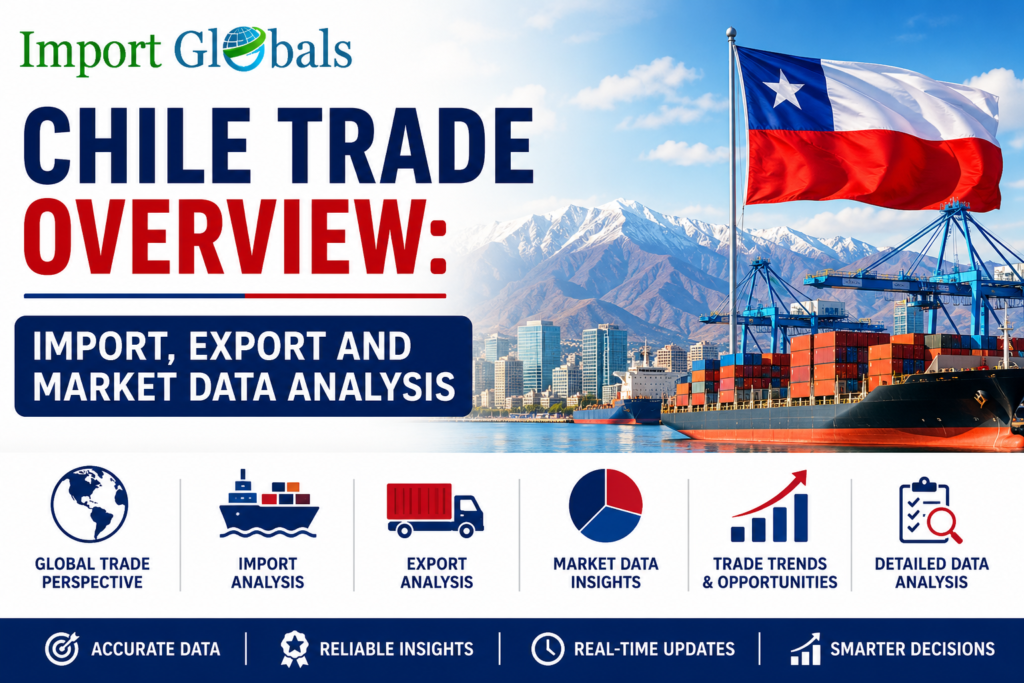
Chile is one of Latin America’s leading trading economies, driven by its strong mining industry, globally competitive agricultural and food sectors, growing renewable-energy capabilities, and extensive trade relationships with Asia, North America, Europe and Latin America. It has a Pacific coast and myriad trade agreements, which also has helped it become a player in international trade.
Companies engaged in international sourcing, manufacturing, importing, exporting, logistics and market research can use Chile Import Data and Chile Trade Data to analyze product movement, supplier markets, destination countries and changing commercial opportunities. The uploaded Philippines trade overview follows the same broad structure of introduction, trade role, imports, exports, customs information, business benefits, industries, outlook, conclusion, CTA and FAQs.
Latest official data point to continued momentum in Chilean trade Between January and July 2026, Chile’s total trade was US$125.641 billion, a 9.6% increase from the same period of 2025. Goods exports increased 15% from a year earlier to US$70.603 billion, surpassing the US$70 billion mark for the first time in a January-July period.
Chile Customs Data, Chile Shipments Data and other types of trade intelligence can help organizations to understand the movement of goods across international markets. Businesses analyze the product descriptions, HS codes, shipment quantities, trading entities, countries, ports and other commercial information available depending on the source and the coverage of the dataset.
THE SIGNIFICANT ROLE OF CHILE IN GLOBAL TRADE ACTIVITIES
Chile is one of the world’s most open economies, with globally competitive natural-resource industries and an expanding base of value-added manufacturing, food production and international services.
The country is well known for exporting copper, lithium-based products, fresh fruit, salmon, wine, forestry products, chemicals, seafood and other industrial and agricultural products. Chile Trade Statistics allow companies to monitor the performance of these industries in international markets, and changes in global demand.
The latest figures underscore the continuing importance of mining to Chile’s export economy. Chile’s mining exports totaled US$43.335 billion in January–July 2026, representing 61.4% of the country’s goods exports and rising 21.7% year-on-year. Over the period copper exports amounted to US$35.605 billion and lithium export revenues were around US$3.713 billion.
At the same time, non-mining exports reached US$27.267 billion, up 5.8%. Food exports hit a new record of US$8.306 billion in the first seven months of 2026.
Therefore, using Chile Trade Data, companies can assess the traditional commodity sectors, as well as the increasingly diversified non-mining export activities of the country.
THE COMPREHENSIVE OVERVIEW OF CHILE IMPORTS
Chile imports a wide range of products, including machinery, industrial equipment, vehicles, electrical equipment, fuel and energy products, chemicals, technology products, consumer goods and manufacturing inputs.
Official trade figures out today show imports still growing. Chile’s imports were up 4.0% year over year in the first half of 2026, while goods trade rose 9.6%.
Imports in the second quarter of 2026 were US$24.295 billion, an increase of 7.0% from the same quarter a year earlier, according to the Banco Central de Chile. The rise was mainly due to intermediate goods, in particular energy-related products such as diesel and petroleum.
The analysis of Chile Import Data can help businesses evaluate:
- International supplier markets
- Product sourcing opportunities
- Import demand trends
- Major countries of origin
- Industrial procurement activity
- Competitive product movements
- Supply chain opportunities
- Potential distribution markets
For manufacturers and procurement professionals, Chile Customs Data can also provide useful insight into customs-related trade activity and the documentation associated with international product movements.
THE EXPORT MARKET OVERVIEW OF CHILE
Chile Export Data provides valuable insight into the country’s international commercial performance and the industries that are contributing to export growth.
Chile exports a variety of products including copper, lithium products, gold, chemicals, fish and fish products, salmon, fresh fruit, wine, forestry products, food products and manufactured products.
Chile’s goods exports in the latest data for January-July 2026 rose 15% to US$70.603 billion. Exports alone were US$10.248 billion in July, a 20 percent increase over the same month last year and the highest monthly export value on record.
Mining sector still contributed significantly, but non-mining industries kept growing as well. Record volumes of food exports were achieved including products such as salmon, mussels, frozen berries, beef, dairy products, frozen cherries and olive oil.
Chile Export Data can help businesses identify:
- Potential international buyers
- Growing destination markets
- Product demand trends
- Export competitors
- Industry-specific trade opportunities
- International distribution channels
- Opportunities for market diversification
Chile’s food exports reached 147 countries during the first seven months of 2026, demonstrating the importance of destination diversification for Chilean exporters.
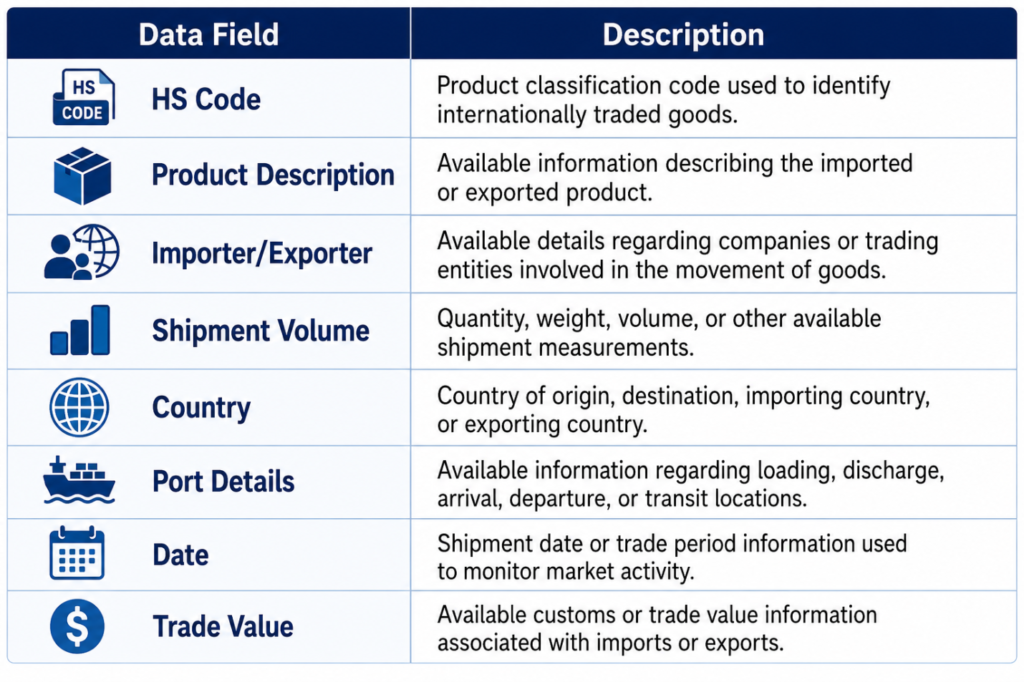
WHAT DETAILS ARE INCLUDED IN CHILE CUSTOMS DATA?
Chile Customs Data and other available trade datasets can contain different fields depending on the source, reporting requirements, type of record, and level of commercial coverage.
Commonly available information may include:
THE EFFECTIVENESS OF IMPORT-EXPORT DATA PROVIDERS IN BUSINESS GROWTH
Import and export data providers can help companies to grow their international business through better market analysis.
Companies looking to expand into new markets often need to identify potential customers, evaluate suppliers, track competition, gage demand for products and understand international trade routes. Chile Trade Data can assist these activities by giving structured information on imports, exports, products, countries and commercial activity available.
Chile Shipments Data can bring shipment level visibility where detailed records are available. Businesses use this information to analyze product movement, frequency of shipments, logistics patterns and possible business relationships.
Access to Chile Import Data and related trade intelligence can support:
- Market research
- Buyer identification
- Supplier analysis
- Competitor monitoring
- Product research
- International sourcing
- Supply chain planning
- Export market analysis
Reliable trade intelligence can help businesses compare historical and current performance to identify changing market conditions.
HOW DOES CHILE IMPORT-EXPORT TRADE DATA PROMOTE BUSINESS GROWTH?
• Identification of global buyers and suppliers
Chile Trade Data can help businesses research targeted product categories and identify markets involved in relevant import and export activities.
The data available can be analyzed by companies to support potential buyer, supplier, manufacturer, distributor and procurement opportunity identification.
• Competitor shipment analysis
Chile Shipments Data helps businesses understand the available shipment activity within specific product categories.
Analysis of shipment frequency, product flow, trading behavior and destination markets can help companies to improve competitive market strategies.
• Supply chain optimization
The analysis of Chile Import Data can help organizations understand supplier markets, product sourcing patterns, and changing import conditions.
Such insights can help in inventory planning, supplier diversification, procurement strategies and logistics decision making.
• Expansion into emerging industries
Chile’s trade economy remains an opportunity for mining, lithium-related industries, renewable energy, food production, seafood, agriculture, chemicals and advanced industrial sectors.
Latest Chile Trade Statistics shows strong growth in mining exports between January and July 2026, but non-mining and food exports also reached significant figures.
THE LATEST BENEFICIARIES OF CHILE TRADE DATA
• Mining and copper industry
One of the main beneficiaries of Chile Export Data and Chile Trade Statistics is the mining sector.
Companies engaged in copper, lithium, mining equipment, industrial materials and related supply chains can use trade intelligence to assess international demand and destination markets.
Mining exports in January-July 2026 totaled US$43.335 billion, of which copper exports made US$35.605 billion.
• Lithium and battery supply chain
Chile is still a major player in the world’s lithium markets. Companies operating in the areas of battery materials, energy storage, electric vehicles and industrial minerals can use Chile Trade Data to track market developments and product flows.
Chile’s lithium export revenue amounted to about US$3.713 billion in January-July 2026, SUBREI said.
• Food and agricultural industry
Chile Export Data gives the food and agricultural industries the information to monitor international demand and find destination markets.
The nation’s food exports reached a record $8.306 billion in the first seven months of 2026. Salmon, mussels, frozen berries, dairy products, beef, frozen cherries and olive oil all saw growth.
• Seafood and salmon industry
The seafood sector is a key element of Chile’s non-mining export economy.
Chile Trade & Chile Shipment Data help seafood processing, cold-chain logistics, packaging and international distribution businesses to assess available product movements and export market opportunities.
• Machinery and industrial equipment industry
Chile Import Trade Data helps machinery & engineering companies to analyze and find out trends in industrial buying and potential supplier markets.
Official statistics show that capital goods, intermediate goods and energy-related imports are still major components of Chile’s external trade.
WHY IS CHILE SHIPMENTS DATA IMPORTANT FOR INTERNATIONAL TRADE ANALYSIS?
Chile Shipments Data can be valuable for businesses seeking greater visibility into available international product movements.
Depending on the dataset coverage, shipment-level information can help organizations analyze:
- Product movements
- Importer activities
- Exporter activities
- Shipment frequency
- Supplier relationships
- Customer purchasing patterns
- Port-related information
- International sourcing networks
- Logistics routes
By combining Chile Shipments Data with Chile Customs Data, businesses can develop a broader understanding of both shipment-level activity and national trade performance.
Researchers, exporters, importers, manufacturers, investors, and procurement professionals can use available trade intelligence to conduct market research and evaluate potential commercial opportunities.
THE FUTURE TRADE OUTLOOK OF CHILE TRADE INTELLIGENCE
The future outlook for Chilean trade is underpinned by ongoing international demand for minerals, food, agricultural products, seafood and other export categories.
Trade is growing strongly in 2026, official figures show. Total goods trade rose 9.6 percent in the first half of the year, with exports up 14.2 percent and imports up 4.0 percent.
Banco Central de Chile also reported strong export growth in the second quarter of 2026. Total exports came in at US$31.512 billion, up 19.2% on the previous year, led by mining products such as copper concentrates, copper cathodes, lithium carbonate and gold. Industrial exports increased 8.7%.
The ongoing advancement of digital trade systems, customs modernization, analytics and data-driven supply chain management could further enhance the value of Chile Customs Data and Chile Trade Statistics to firms involved in international market research.
Chile Import Data, Chile Export Data and Chile Trade Data helps in identifying buyers and suppliers, tracking competitors, product research and planning for international expansion with businesses increasingly relying on structured market intelligence.
CONCLUSION
Chile continues to develop as an important trading economy in the Latin American and world marketplace. Its mining resources, food and agricultural industries, seafood exports, international trade relationships and access to Pacific trade routes all provide a wealth of opportunities for businesses involved in importing, exporting, sourcing and distribution.
Chile Import Trade Data provides a platform for organizations to analyze supplier markets, product sourcing trends and developing import demand.
Chile Customs Data, Chile Shipments Data, Chile Export Data and Chile Trade Statistics can also provide useful information for businesses on product flows, international markets, competitors and commercial opportunities.
Chile’s exports of goods amounted to US$70.603 billion in the January-July 2026 period, 15% more than in the same period of 2025, according to the latest official figures. Total trade rose 9.6 percent to US$125.641 billion.
Chile Trade Data and shipment level intelligence can help companies looking to expand internationally to identify potential buyers and suppliers, assess competitors, analyze market demand and build more informed global business strategies.
CTA
Looking for an expansion in your business on a global scale?
Import Globals provides businesses with international trade intelligence for market research, buyer and supplier identification, competitor analysis and global expansion.
Utilize Chile Import Data, Chile Customs Data, Chile Shipments Data and other international trade data sets to enhance your market research and business development strategy. Visit www.importglobals.com or email at info@importglobals.com to strengthen your international trade presence while accelerating your global business growth.
FAQs
Que – Why is Chile Import Data Considered Helpful for Business Growth?
Ans – Chile Import Data provides a solution to analyze supplier markets, monitor import demand, evaluate sourcing options, research competitors and use data to develop a strategic procurement strategy and help business grow.
Que – What data is available in Chile Customs Data
Ans – Chile Customs Data contains a variety of information like HS codes, product description, importer or exporter name, quantity of shipment, trade value, country information, port information, shipment or declaration date etc. depending on the dataset and coverage.
Que – What is the importance of Chile shipments data in market research?
Ans – Chile Shipments Data helps companies to analyze available shipment movements, product flows, supplier relationships, shipment frequency, logistics patterns and potential commercial opportunities.
Que – What was the performance of exports in 2026?
Ans – Chile’s exports of goods reached US$70.603 billion between January and July 2026, 15% more than in the same period of 2025.
Que – Which industries benefit the most from Chile Trade Data?
Ans – Industries that can benefit from Chile Trade Data are mining, copper, lithium industries, food processing, agriculture, seafood, salmon, machinery, industrial equipment, international logistics.
Que – Chile Trade Statistics – Latest Updates
Ans – The overall trade of Chile totaled US$ 125.641 billion from January to July 2026, an increase of 9.6% year-on-year, the latest official figures show. Exports of goods reached US$70.603 billion and of mining US$43.335 billion.
Que – Why is Chile Export Data important for business?
Ans – Chile Export Data assists the companies to identify the global demand, analyze the target markets, track the export sectors, research the competitors and find prospective international buyers and distribution opportunities.
Que -How frequently is the Chile’ trade data updated?
Ans – ‘Chile’ trade data is updated on a monthly basis.
Que -Where can businesses obtain detailed Chile trade data?
Ans -Visit www.importglobals.com or drop an email at info@importglobals.com to access Philippines trade data.
